A Revolution in Our Understanding of Language
The school of generative linguistics, largely associated with the distinguished American linguist and philosopher Noam Chomsky, is considered one of the most influential and controversial approaches to the study of language in the 20th century and beyond. This school, which began in the 1950s, fundamentally transformed our view of language and the human mind and opened a new path in the science of linguistics.
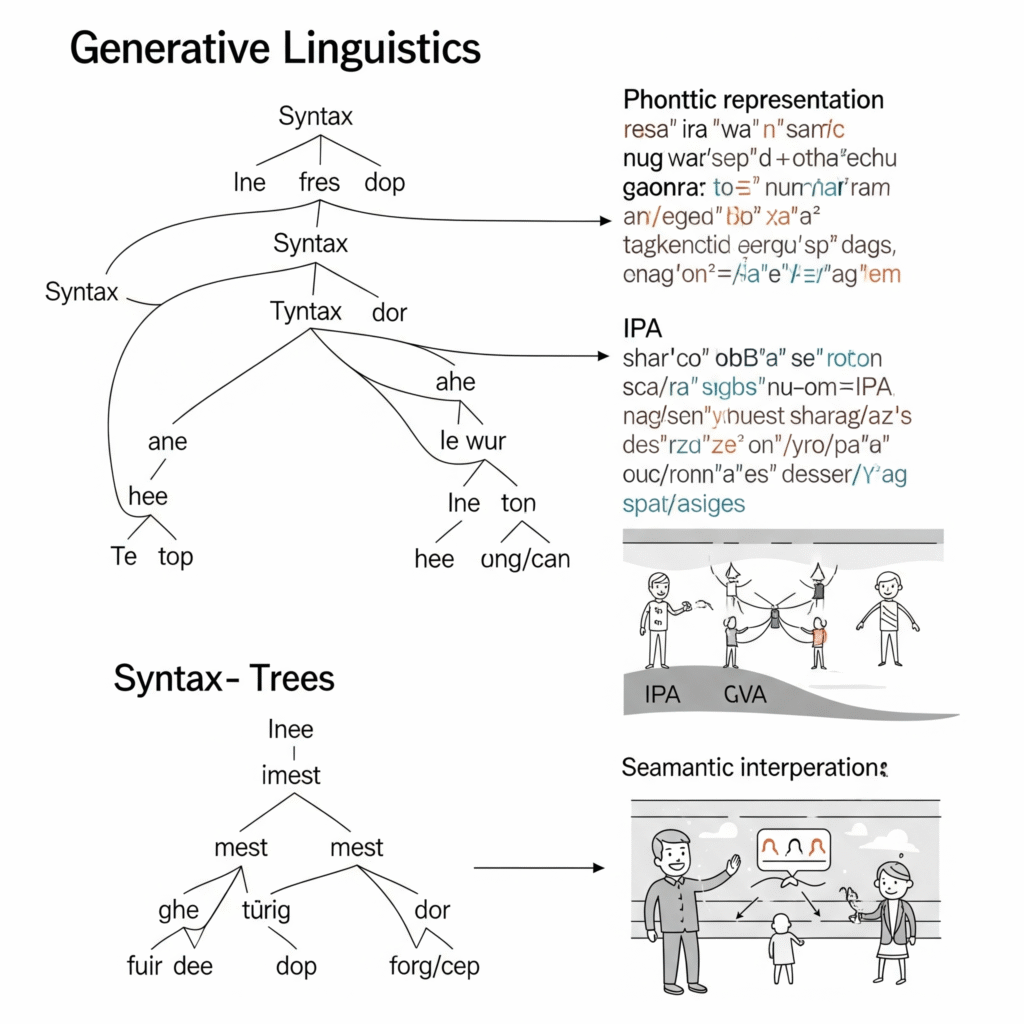
The Rise of a Revolution: From Behaviorism to Mentalism
Before Chomsky’s emergence, linguistics in America was dominated by the behaviorist approach. In this view, language was seen as merely a set of learned habits and responses to external stimuli, and any discussion of the mental or innate structures of language was questioned. But Chomsky challenged this paradigm with his theories, especially Syntactic Structures (1957) and Aspects of the Theory of Syntax (1965). He argued that language is not simply a collection of heard sentences, but an infinitely creative system. Humans are capable of producing and understanding an infinite number of new sentences that they have never heard before. This ability cannot be explained simply by imitation or habit. To explain this phenomenon, Chomsky proposed a revolutionary concept: the Innate Language Faculty or Universal Grammar (UG).
Central Concepts of the Generative school
Universal Grammar – UG
The basis of Chomsky’s theory is that humans are born with an innate ability to learn language. This ability involves a set of universal principles and parameters that underlie all human languages. UG acts as a genetic “blueprint” for language, helping a child quickly and easily learn the complex grammar of their native language with limited exposure to linguistic data. This concept was a serious challenge to “blank slate” theories in psychology.
Competence vs Performance
Chomsky distinguished between Linguistic Competence and Linguistic Performance:
Competence: is the unconscious and idealized knowledge of a speaker/listener of his/her language. This is what UG explains; the abstract rules that allow a person to produce and understand correct sentences.
Performance: The actual use of language in specific situations. Performance can be affected by non-linguistic factors such as fatigue, distraction, or memory limitations. Chomsky believed that the linguist’s primary task was to study his or her own ability, since action is only an incomplete reflection of this underlying knowledge.
Deep Structure-Surface Structure
In early versions of generative theory, Chomsky proposed that each sentence has two levels of structure:
Deep structure: an abstract, basic representation of the sentence that contains all the necessary semantic information. This level is closer to the rules of universal grammar.
Surface structure: the form of the sentence that we hear or write.
Transformational Rules transform a deep structure into a surface structure. For example, a news sentence (“He is reading the book”) and its related interrogative sentence (“Is he reading the book?”) may be derived from a common deep structure that has been transformed into two different superstructures by applying different transformations.
Minimalism
Over time, Chomsky and his followers attempted to simplify and “economicalize” the theory. In the Minimalist Program, the latest version of generative theory, the focus is on finding the minimum set of principles and parameters necessary to explain language. The goal is to uncover the fundamental principles of the computational system that produces language in the human mind.
The influence and importance of the school of generative linguistics
The impact of generative theory on linguistics and beyond has been unprecedented:
Cognitive revolution: Chomsky’s theory was a major driver of the “cognitive revolution” in the humanities and social sciences, influencing disciplines such as psychology, philosophy of mind, and computer science.
Foundation of modern theoretical linguistics: Much research in syntax, semantics, and phonology has been inspired by the concepts and methods of generative theory.
Exploring linguistic differences and similarities: UG theory provides a framework for understanding why languages have deep structural similarities despite their apparent differences.
Child language learning: This school helped to better understand the phenomenon of language acquisition in children and showed how children acquire complex knowledge of grammar with limited linguistic input.
Criticisms and challenges
Despite its remarkable successes, the Generative school has also faced serious criticism: Many criticisms focus on the impossibility of directly observing mental structures and the universality of generative rules. Some argue that there is insufficient empirical evidence to prove UG. Functionalist critics and sociolinguists criticize Chomsky for ignoring the role of language in social communication and the influence of context on language use. Generative theory has become very complex over time, making it difficult for many to understand and apply. Even among generative linguists themselves, there has always been debate and disagreement over the details and precise nature of the rules of universal grammar.
Without a doubt, it is one of the most important and influential paradigms in the history of linguistics. By focusing on the innate human capacity for language and attempting to discover the fundamental rules that underlie all languages, this school transformed our understanding of language from a purely social phenomenon to a cognitive and biological one. Although this approach has always been controversial, it has been able to stimulate a lot of research in various fields of linguistics and remains one of the main pillars of theoretical linguistics worldwide. It is impossible to understand language without taking into account the profound influences of Chomsky and the generative school.